

Three versus eighty is not a review problem
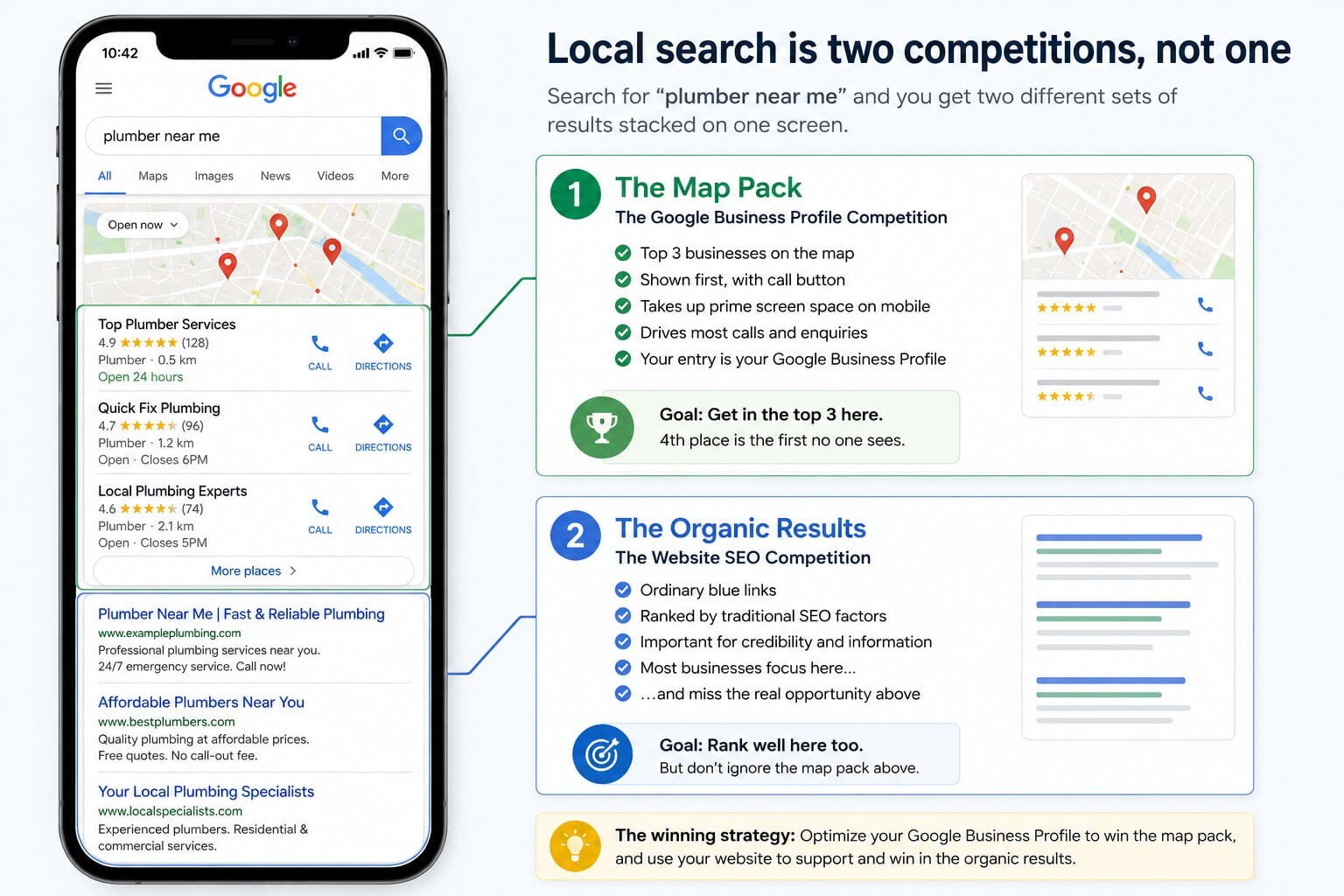
Here is what actually happens when someone searches for what you sell. Three listings appear in the map. Nobody reads them carefully. They scan the stars, glance at the number in brackets, and tap the one that looks like the safe choice. That decision takes about two seconds and your website is not involved in it at all.
Against a business with eighty reviews, three does not read as "new". It reads as "nobody has vouched for these people". A 5.0 average from three reviews loses to a 4.6 from eighty almost every time, because volume is what makes a rating believable. That is the uncomfortable part: you are not being judged on quality, you are being judged on evidence of quality, and those are different things.
The gap is rarely because the competitor is better. It is because at some point they started asking, and you did not. That is the whole difference. Eighty reviews over four years is one review every eighteen days — a single WhatsApp message, sent more often than you have been sending it.
And it compounds. Reviews feed prominence, one of the three things Google weighs when ranking local results, so the business with more of them tends to appear higher, gets seen more, and collects more. You do not have to win that race. You have to stop being dismissed in the two-second scan.
Start here: get your review link
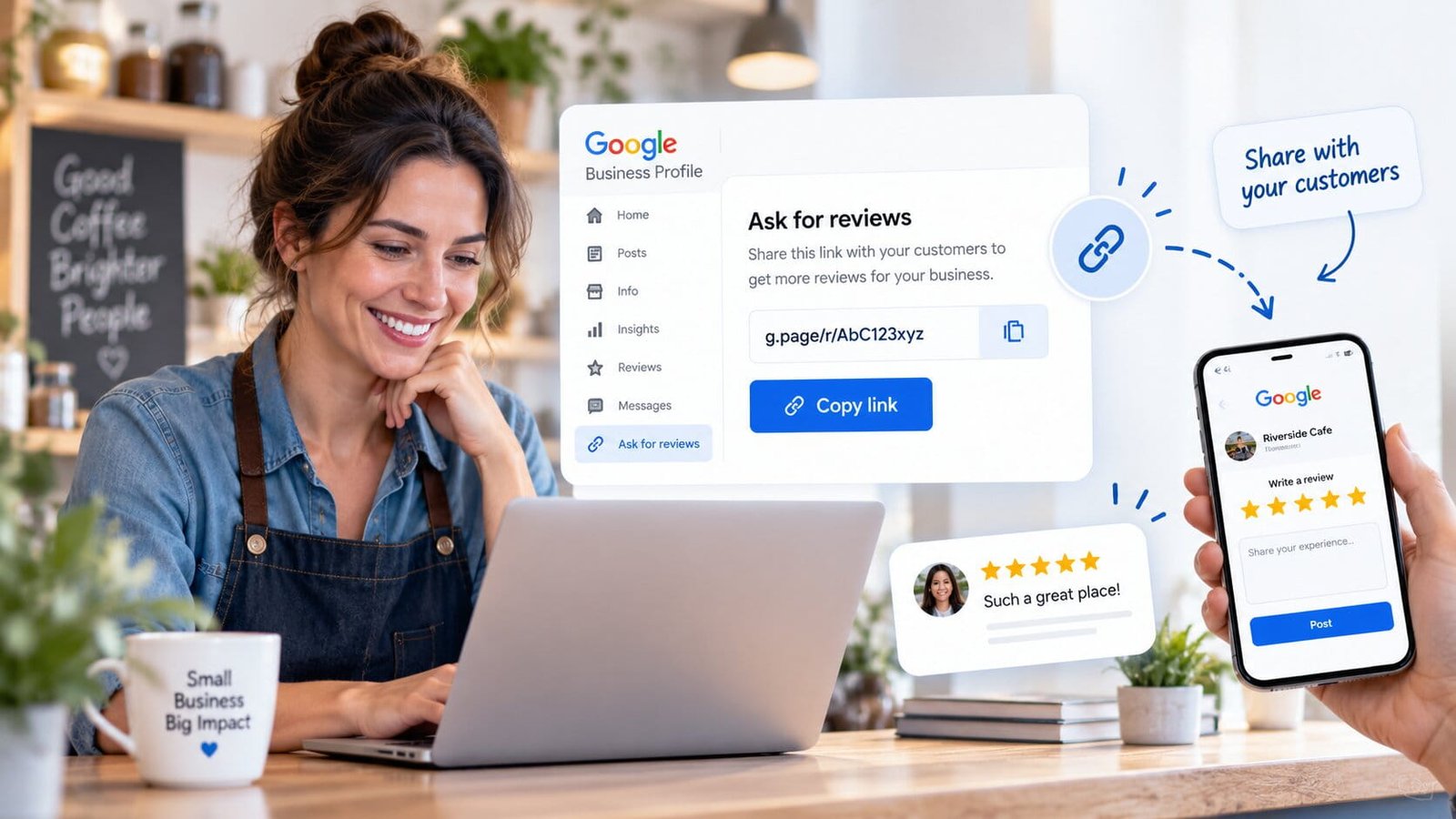
Almost every failed review request fails for one boring reason: the customer was asked to go and find you. Nobody does that. They open Google, get distracted by something else, and your review never existed. A direct link removes four steps and roughly doubles what you collect.
Search your own business name while logged into the Google account that manages it, or go to business.google.com. You should see your own listing with management options on it.
It sits with the other management actions. Google hands you a short link that looks like g.page/r/ followed by a string of characters.
Tap it. It should open the star box for your business immediately. If it lands on a search results page or the wrong branch, the link is wrong — fix it now rather than discovering it after twenty sends.
Pin it in a note on your phone home screen, or save it as a WhatsApp message to yourself. If finding the link takes longer than sending the message, you will stop sending the message.
That link is the whole mechanism. Everything below is just deciding who receives it and when.
"I feel bad asking"
This is the real blocker, and it is worth sitting with for a moment, because no template fixes a reluctance to send it. Most owners I work with are not disorganised about reviews. They are embarrassed. Asking feels like begging, or like admitting you need help, or like putting a customer on the spot after they have already paid you.
Three things usually dissolve it.
It is a small favour, not a big one. You are asking for ninety seconds from someone you just spent hours or days helping. People who were happy with the work are generally glad to be given a way to say so — they just never think of it unprompted. The awkwardness is entirely on your side of the conversation.
You are asking for the next customer, not for yourself. This reframe does more work than any other. A review is not a trophy; it is the thing that helps the next nervous person decide whether to trust a small business they have never heard of. Say that out loud when you ask — "it really helps other people find us" is true, and it is easier to say than "please rate me".
Ask once, then let it go. Most of the dread comes from imagining a nag. One message, one follow-up, then silence. Nobody has ever thought worse of a business for a single polite request, and if someone ignores it, that is a perfectly acceptable outcome. Send it and move on.
What kills the habit is making each request a decision. Decide once — everyone gets asked, on the day the job ends — and it stops being a thing you have to summon courage for.
The messages, ready to send
Change the name, keep the shape. All three are deliberately short, mention why it matters, and put the link where a thumb lands.
Two details in there matter more than they look. The email invites a complaint privately — that is not a trick, it is how you avoid finding out about a problem by reading it in public. And the follow-up is almost apologetic about the interruption, which is exactly why it works: a large share of reviews arrive after the second message, not the first.
One thing to avoid: do not paste the same message into a group chat or a broadcast list. A batch of near-identical reviews arriving within an hour of each other looks manufactured, to Google and to readers.
If your customers walk through a door
Messaging works when you have someone's number. For a café, clinic, salon or workshop, half your customers are people you will never message — so the ask has to be physically present at the moment they are happiest.
Make a small card for the counter. Generate a QR code from your review link with any free generator, print it at about the size of a playing card, and put six words above it: "Enjoyed it? Tell Google about us." Stand it beside the payment terminal, where people are already holding their phone and waiting for something to finish.
The same QR works on the back of a receipt, on an invoice footer, on the service sticker you leave on a serviced unit, or on a sticker inside the door. What does not work is a poster on a wall across the room. The distance between noticing it and being able to act on it has to be nothing.
A card is passive, though — it collects from the enthusiastic minority. The spoken version outperforms it several times over: "If you have a second, there is a QR on the counter — reviews really help us." Staff will feel strange saying it for about two days, then it becomes as unremarkable as asking if someone wants a receipt.
"I asked and nobody did it"
This is the most common complaint, and it is almost never a customer problem. When a round of requests produces nothing, it is usually one of four things.
You asked too late. Gratitude has a short half-life. A request sent the same day gets a very different response from one sent three weeks after the job, when the relief has faded and you have become a company that wants something. If you only change one thing, change the timing.
You asked the wrong way. "Please review us on Google" with no link is a chore. A tapable link with one line of context is a favour. Asking in person and then never sending the link is the most common version of this — the intention evaporates the moment they walk out.
You asked once, quietly. A single message competes with everything else in someone's phone. The nudge above is not pestering; it is acknowledging that people are busy and messages get buried.
You asked five people. Expect roughly one in four or five to follow through, and fewer if the link is missing. Five requests producing one review is a normal week, not a failure — it just means twenty reviews takes a hundred asks, which is a year of ordinary trading for most small businesses.
There is also a quiet fifth cause: nobody owns it. If asking is something you do when you remember, you will remember in bursts. Attach it to something that already happens without fail — the final invoice, the handover message, closing the job in your book — and it survives busy weeks.
Three to twenty: what it actually takes
Assuming a business serving twenty to forty customers a month and asking every one of them, this is the shape of it. Slower than you want, faster than doing nothing for another year.
Week one · setup
Link found, tested and saved. Templates in your notes app. QR card on the counter if you have one. Every past review replied to, including the old ones — an unanswered review page reads as an abandoned business.
Weeks two to four · the backlog
Message the last two or three months of customers — people who still remember you fondly. Spread it over a fortnight rather than one afternoon. This is the only time you will have a stock of goodwill sitting unused, and it is usually worth five to eight reviews.
Months two and three · the habit
Every completed job gets the message on the day, plus one nudge. Two to five reviews a month is a realistic rate. You should be somewhere in the low teens by the end of month three, with recent dates — which matters as much as the count.
Months four to six · past the threshold
Twenty-plus, and the tone of your enquiries changes. People stop asking whether you are legitimate and start asking about price and availability. That shift is the actual return on this work — not the number itself.
Do not chase a sudden pile. Twenty reviews appearing in one week looks exactly like twenty bought reviews, and Google's filters treat them accordingly. A steady trickle is both safer and more persuasive, because a reader checking dates can see the business is still alive.
Four shortcuts that will cost you
Every one of these is common, and every one of them risks the profile you have been building.
Paying for reviews, in any form
A discount, a voucher, a free drink, a lucky draw entry. Google's policy is explicit about incentives, and the reviews can be stripped out later along with damage to the profile. Ask everyone as often as is reasonable — you simply cannot pay for the answer.
Buying reviews outright
The sellers are easy to find and the results are easy to spot: accounts with no history, oddly formal English, a cluster of five-stars in one week, reviewers who have also praised a hardware shop in another state. Detection is not the only risk — a prospect who notices trusts you less than if you had three honest reviews.
Review gating
Asking "how did we do?" first and only sending the link to the people who answer warmly. It feels sensible and it breaches the policy. Ask everyone you served properly; the unhappy minority mostly do not bother writing, and the ones who do tell you something you needed to know.
Reviewing yourself, or your staff doing it
Owners, family and employees posting reviews is a conflict of interest under the policy, and it is transparent to anyone who clicks a profile name. Same for review-swapping with the business next door.
The honest route is slower for about two months and then permanently better. There is no version of this where a shortcut leaves you with a review page you would be happy to show someone.

The bad one
One day you will open your phone to a one-star review, possibly unfair, possibly from someone who was never even a customer. The feeling is genuinely awful and it passes. What matters is what you do in the next twenty-four hours.
First, understand who the reply is for. It is not for the reviewer — that relationship is probably already decided. It is for the next hundred people who read the review while deciding about you. Those people are not really judging whether the complaint is fair. They are judging whether you seem like the kind of business that handles a problem like an adult. A calm, specific reply under a harsh review can reassure a reader more than another five-star would have.
Reply within a day. Keep it under four sentences. Never argue the facts in public, never mention what the customer got wrong, and never write anything while you are still angry — draft it, then reread it an hour later.
You can report a review that breaks Google's content policy — spam, a competitor who was never a customer, offensive content, or one posted about the wrong business. Do it, but do not wait on it: removal is not guaranteed and can take weeks. A review that is merely harsh and honest will stay, which is the point of the next paragraph.
The real defence is volume. One bad review among six is a red flag; the same review among sixty is a bad day that a reader scrolls past. Businesses that ask consistently are not spared bad reviews — they are just much less affected by them. If a single one-star can sink your average, the problem is not the review.
Reply to the good ones too
Most small businesses reply only to complaints, which makes the review page read like a page of problems. Reply to everything, briefly. Two sentences, mentioning the specific thing they mentioned, no template phrasing repeated twenty times in a row.
It takes a minute a week and does three things: readers see an owner who is present, reviewers feel noticed and tend to come back, and Google sees an actively managed profile. It also makes the next request easier to send, because asking for a review from a business that visibly reads them is a much smaller thing to ask.
Where the reviews should land
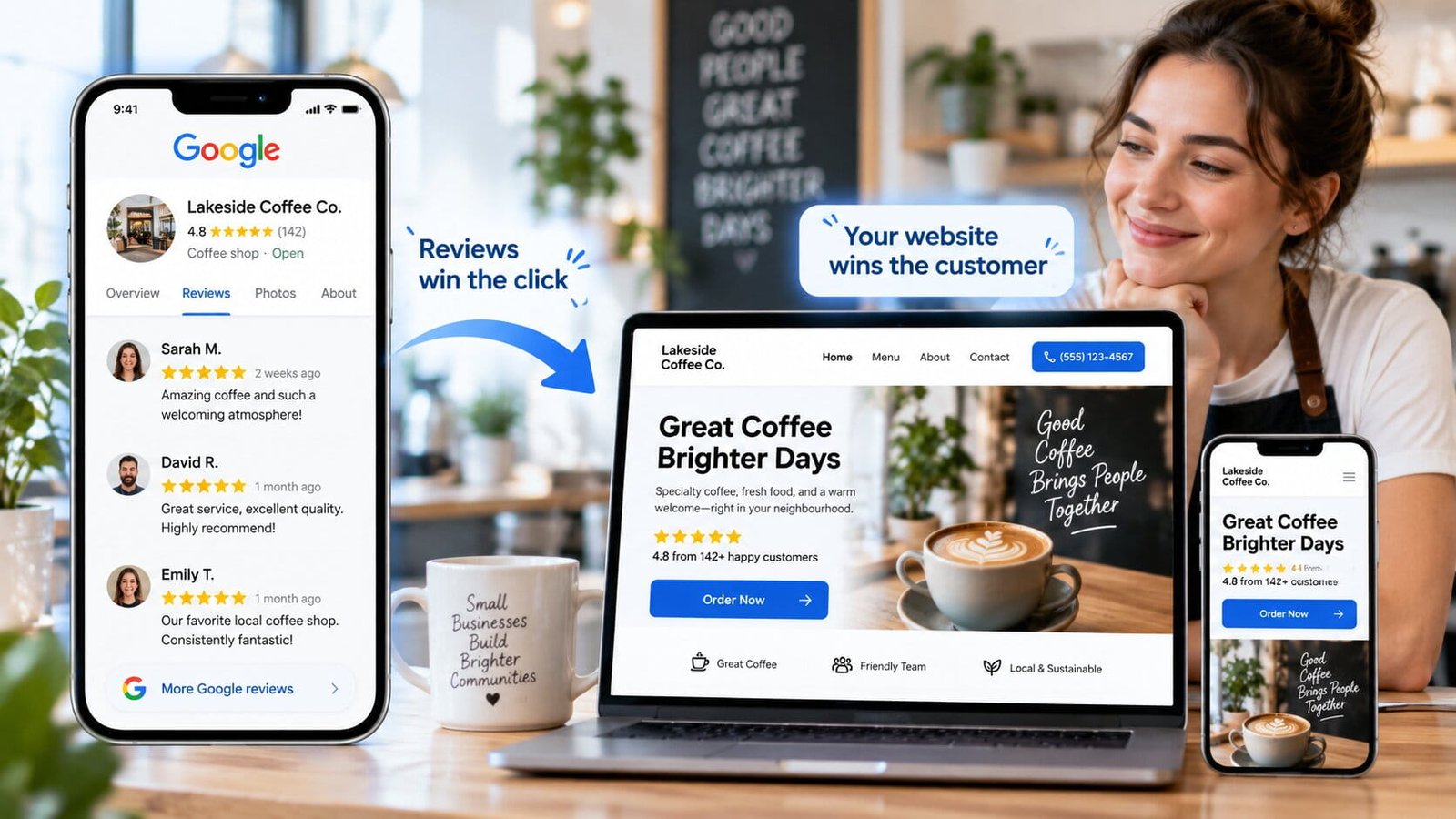
One last thing, because it is where most of this work gets wasted. Reviews win the click. Your website still has to win the job.
Someone who read four good reviews and tapped through to your site arrives already half-convinced — and then finds a homepage that does not say what you do, a phone number they have to hunt for, or a page that takes eight seconds to appear on mobile data. All that trust you collected one message at a time gets spent on a page that cannot hold it.
So put the reviews to work: quote two or three real ones on your homepage with the customer's name, show your star rating and count near your main call to action, and make sure the site says the same thing your profile says. That is the handover point between getting found and getting enquiries, and it is worth getting right before you spend six months collecting reviews.
None of this is clever. It is one message, sent on the day, to every customer, with a link in it — plus the discipline to keep doing it in the weeks when you are busy. The businesses with eighty reviews are not better at this than you. They just started, and did not stop.
Questions owners ask
How many reviews do I actually need?
No fixed number — just enough to look credible beside the businesses you appear next to. If the top three have forty to eighty and you have three, that is the gap doing the deciding. Twenty genuine, recent reviews stops you being dismissed in most local categories.
Can I offer a discount for a review?
No. Incentives of any kind breach Google's policy, and the reviews can be removed later along with damage to the profile. Ask as often as is reasonable — you just cannot pay for the answer.
Should I only ask the happy ones?
Screening first and sending the link selectively is review gating, and it breaches the policy. Ask everyone you served properly — in practice the people who bother to write are overwhelmingly the satisfied ones.
How do I find my review link?
In your Google Business Profile, under "Ask for reviews". It looks like g.page/r/ plus a code, and it opens the star box directly. Test it on your own phone before you send it to anyone.
Can I get an unfair review removed?
You can report one that breaks the content policy — spam, a non-customer, offensive content, wrong business. Removal is not guaranteed and takes days to weeks. A harsh but honest review will stay, which is why volume is the real defence.
Do reviews help my ranking?
They feed prominence, one of the three local ranking signals. But the larger effect is on clicks — two listings can rank side by side and the one with more recent reviews takes most of the calls.
What about Facebook reviews and other platforms?
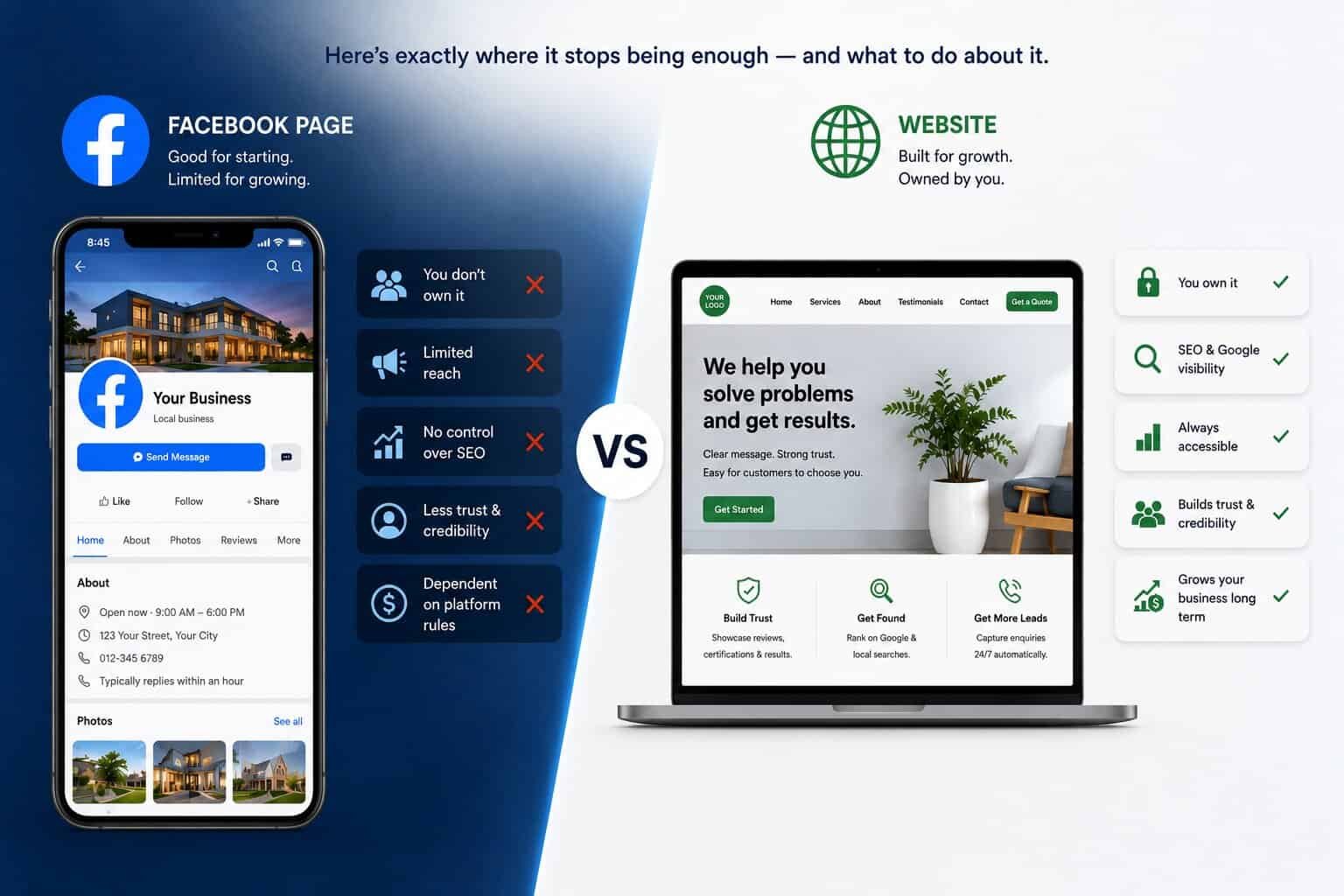
Google first, by a wide margin — it is where the search happens and where the map pack is decided. Add one other platform only if your industry has an obvious one. Splitting requests across four sites leaves you looking thin on all of them.

Collecting reviews and still not getting enquiries?
Then the leak is on the website, not the profile. I'll read your homepage the way a customer arriving from your reviews would, and send back the three specific things losing them — free, within 48 hours.