
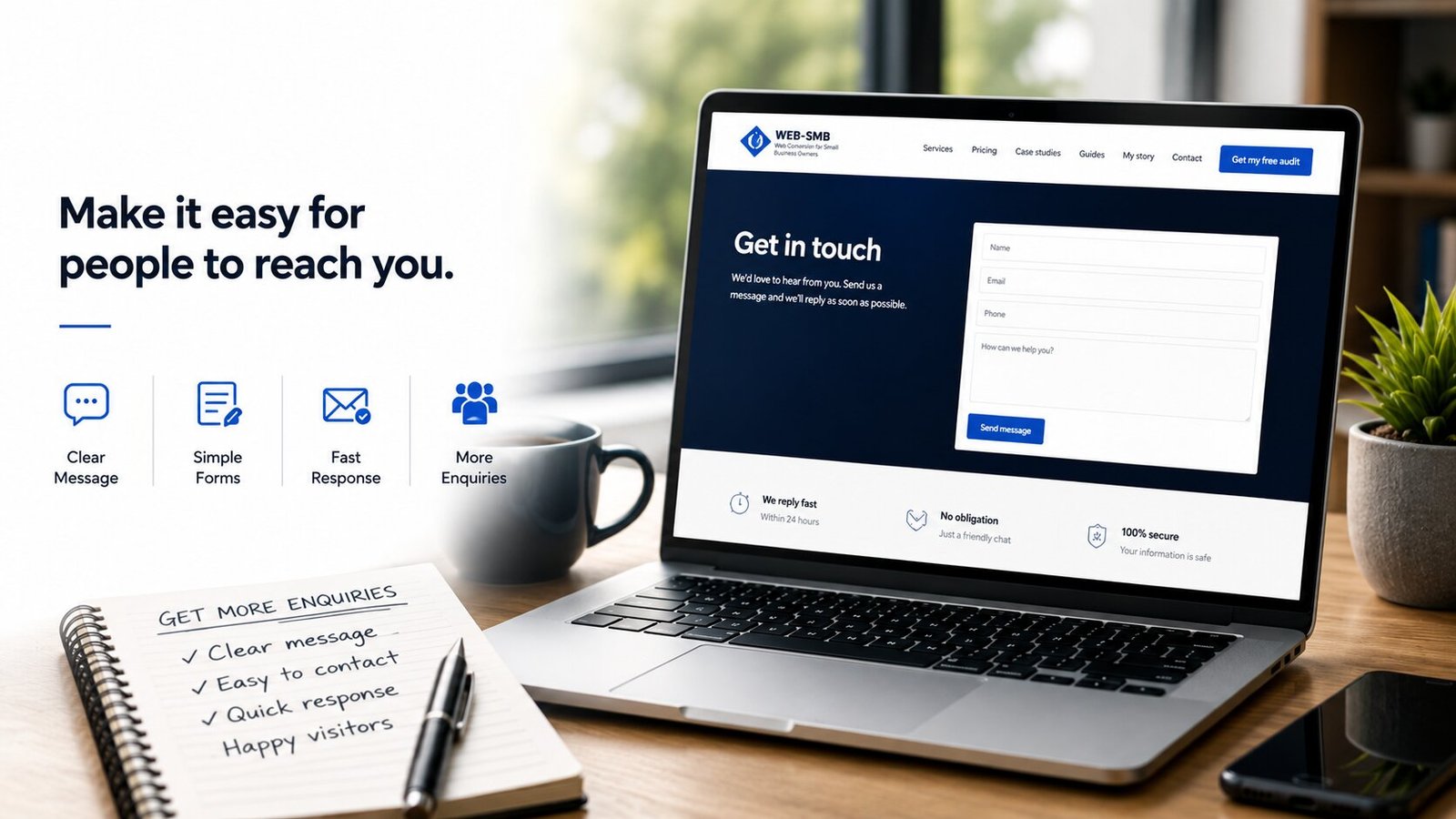
Traffic is not the problem you think it is
Almost every owner who calls me wants more visitors. Almost none of them need more visitors. A site converting one in a hundred does not need twice the traffic — it needs to stop losing ninety-nine people, because improving a bad conversion rate is free and buying traffic is not.
Conversion is not persuasion, and it is not a bigger orange button. It is the removal of friction and doubt: making it obvious what you do, credible that you do it well, and effortless to take the next step. Nearly always, the fix is subtraction.
This series is that work, page by page.
The four questions every visitor asks
In the first eight secondsAm I in the right place?
Answered by the headline, in plain words, above the fold — not by a slogan. If a stranger cannot tell what you sell and who you sell it to from one line, everything below it is wasted.
Can these people actually do it?
Answered by proof, not adjectives. Named clients, real numbers, photographs of finished work, reviews with a person’s name attached. "Professional and reliable" is what everyone says, including the people who are not.
What will this cost me?
The question that quietly kills the most enquiries. A page with no pricing signal at all makes people assume the worst and leave. A band, a starting figure, or an example project is enough — you do not have to publish a rate card.
What happens if I get in touch?
People hesitate because they do not know what they are triggering. Say it: what you will send, how fast, and that there is no obligation. Uncertainty about the next step is friction, and friction is the thing you are removing.
Shortcut
Want the four answers checked on your own site?
That is exactly what the free audit does. Send me your homepage and I will tell you which of the four a visitor cannot answer, and the three changes that would fix it.
Get my free auditWhat good looks like
Owners are told their site needs to convert better without ever being shown one that does. So here is the standard, in the five places it is either present or absent. None of it is design taste — every item is something a visitor either can or cannot do.
A stranger can say what you do within five seconds
The headline names the work, who it is for and roughly where — "Aircon servicing for homes and offices in Johor Bahru", not "Excellence in climate solutions". Read your own first screen to someone outside your industry and ask them what you sell. Their hesitation is your conversion rate.
The proof belongs to a named person
Reviews with a full name, a photo of the actual job, a number you can stand behind. Unattributed praise reads as invented, because most of it is. One specific testimonial from a customer in the same situation as the reader outperforms a wall of five-star quotes.
There is one next step, and it repeats
The same action at the top, in the middle, and at the end — call, WhatsApp, or a short form. Not four options of equal weight. A visitor who has to decide how to contact you often decides to do it later, which means never.
The enquiry step asks for the minimum
Name, contact, and one question about what they need. Nobody abandons a form because it was too easy. Everything else you want to know can be asked in your reply, once the conversation exists.
It answers the objection instead of avoiding it
Price, availability, service area, what happens after they enquire. Sites hide these hoping to force a call; visitors read the silence as bad news and leave. A page that says "most jobs land between X and Y" loses the people who were never going to buy and keeps the ones who were.
What a reasonable enquiry rate looks like
There is no single conversion rate for a website, because the visitor's intent changes everything. Someone who typed your service into Google is a different person from someone who tapped a link in a bio. These are the ranges I see across small business sites — use them to judge each source against itself, not to grade your site as a whole.
| Where they came from | Enquiry rate | If you are well below it |
|---|---|---|
| Google search for your service | 3 – 8% | The page they land on probably does not match what they searched for. Sending every search to the homepage is the usual cause. |
| Your Google Business Profile | 5 – 12% | Highest intent there is — they already chose you and clicked through. If these do not convert, the site is contradicting the listing. |
| Referral or word of mouth | 8 – 20% | They arrived already sold and the site talked them out of it. Usually a missing phone number, a dated look, or no sign the business is still active. |
| Facebook or Instagram profile link | 1 – 3% | Low is normal — this is browsing, not buying. Do not judge the site on this traffic, and do not spend money sending more of it. |
| Paid ads pointed at the homepage | Under 1% | Expected, and the reason most small business ad budgets disappear. Point the ad at a page about that one service instead. |
Count an enquiry as anything that reaches you — form, call, WhatsApp, directions tap. If you are only counting form submissions, your real rate is higher than your analytics says, and you may be about to rewrite a page that was working.
Read these
Live now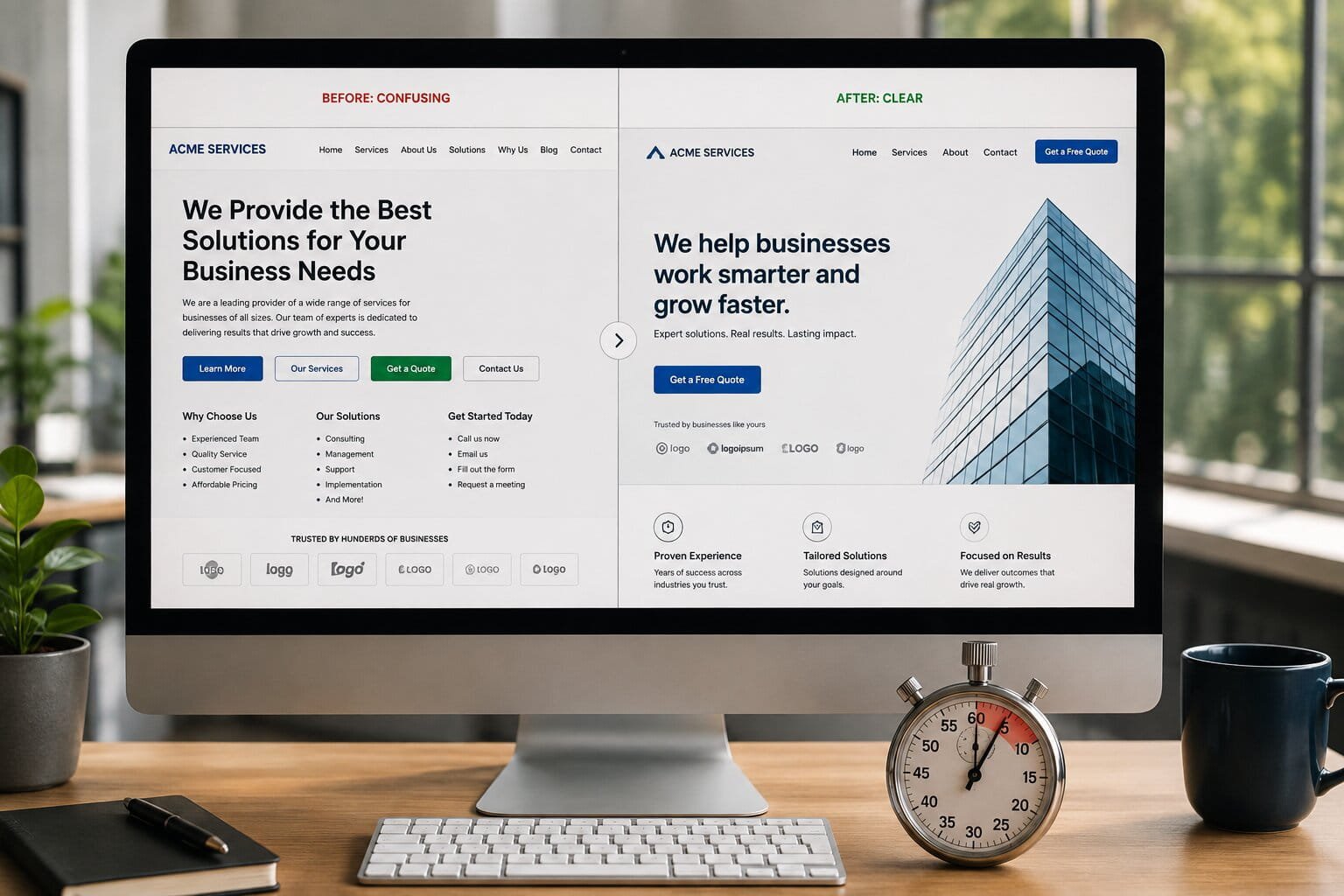
Start here
How to write a homepage that converts
The five sections in order, what each one has to do, and the lines to swap out on yours this week.
9 min read · August 2026
Diagnosis
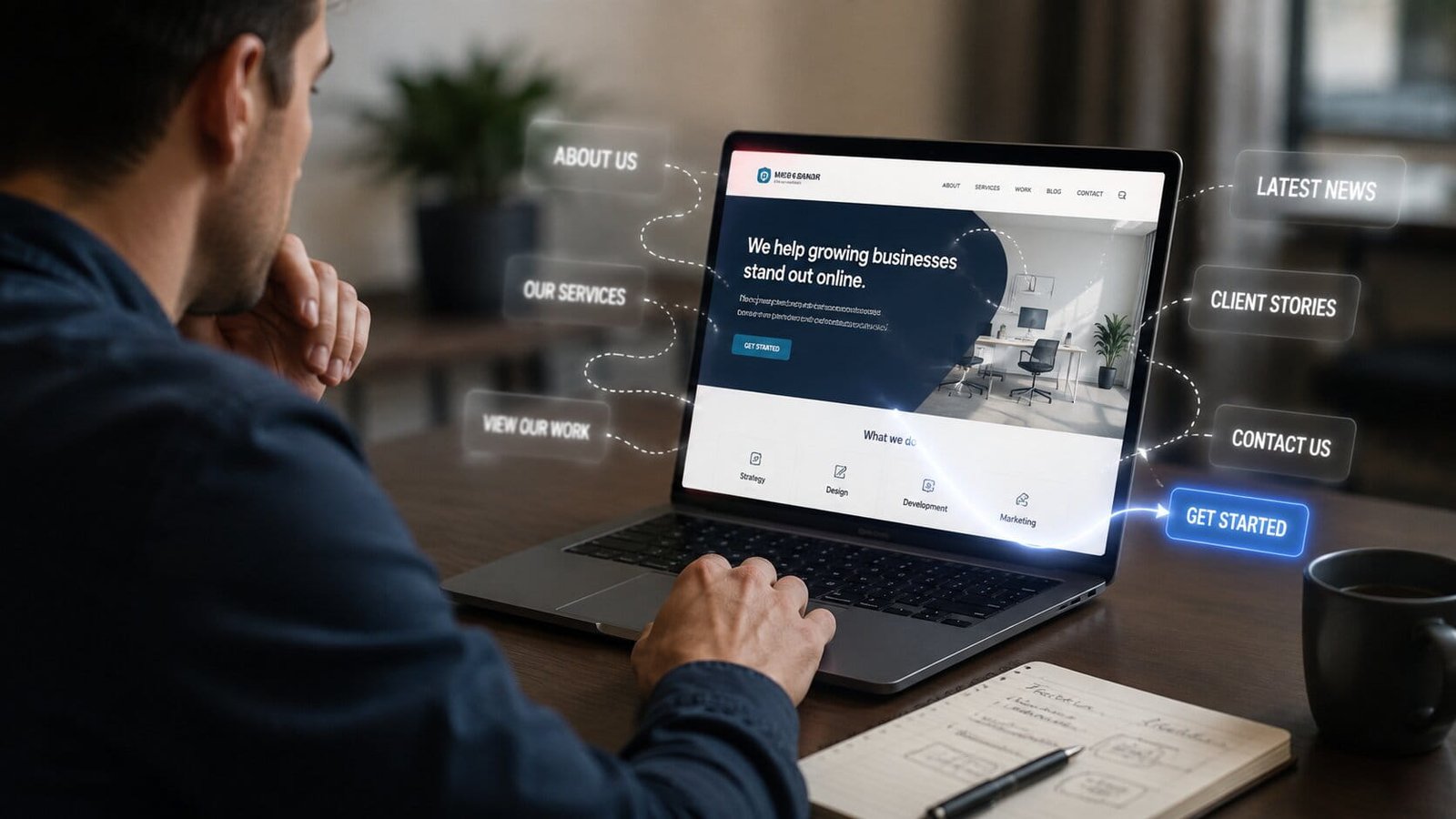
Why your website isn’t converting
The seven causes I find most often in fifteen years of reviews, ordered by what they cost you.
10 min read · August 2026
Coming in this series
Next few weeksWhy your traffic isn’t becoming enquiries
The five leaks between arriving and getting in touch.
Writing a service page that sells
Structure, proof, and the one question most service pages never answer.
Contact forms people actually finish
Field count, labels, and what to promise after they hit send.
Trust signals a small business can earn in a week
What to show when you have no big logos and no awards.
Calls to action that get clicked
Placement, wording, and why "Submit" costs you enquiries.
Related
Where the traffic comes from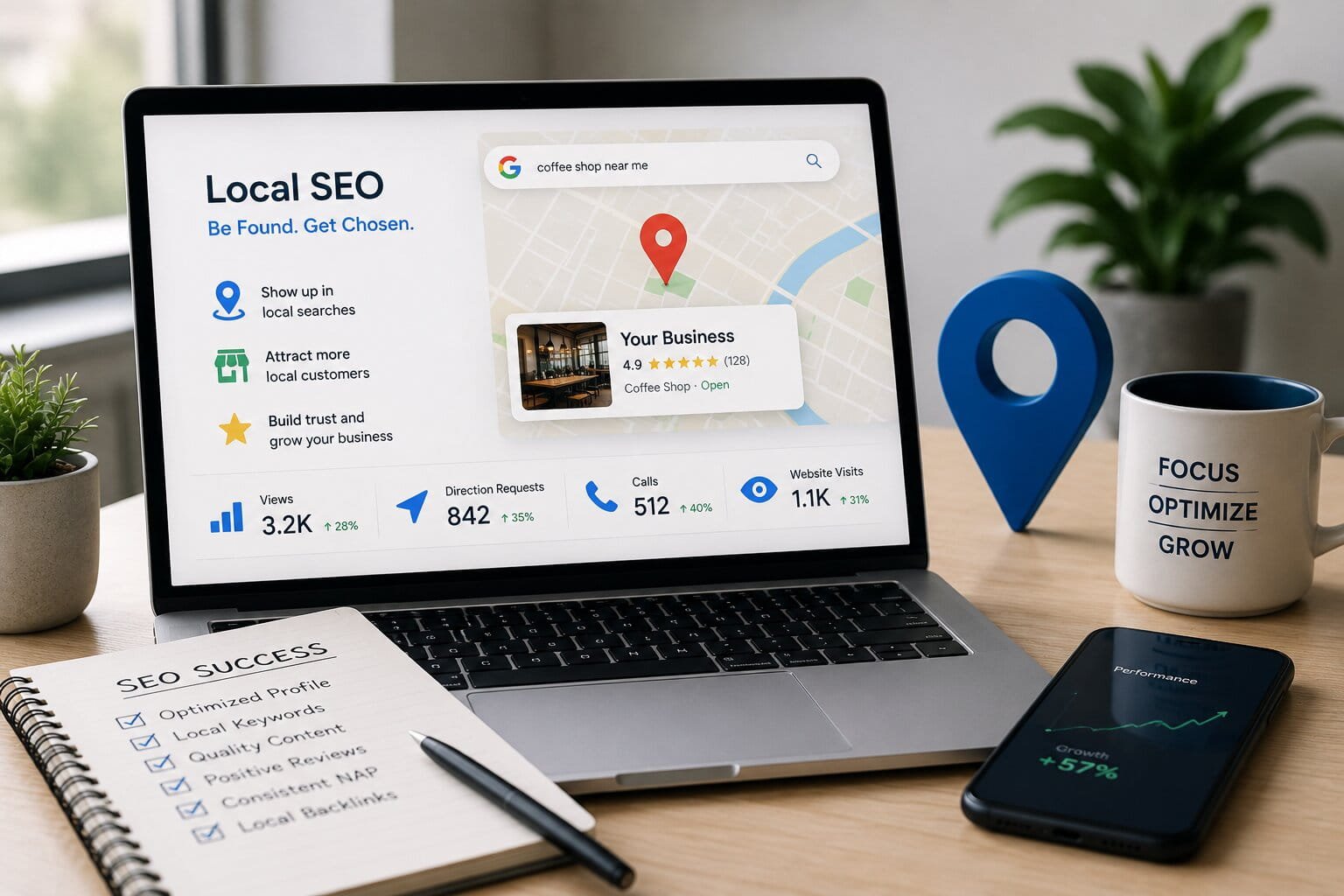
Questions owners ask about conversion
What is a good conversion rate for a small business website?
It depends entirely on where the visitor came from, which is why a single site-wide number is close to meaningless. Someone who searched for your exact service converts several times better than someone who wandered in from a social profile. Judge each source against itself — the table above is the shape I see across small business sites.
How many visitors do I need before I can trust the number?
Around 200 visitors to a page before a rate means anything, and 30 to 50 enquiries before you can compare two versions of it. Below that you are reading noise. Most small businesses never get statistical certainty and do not need it — fix the obvious problems, which are usually visible without any data at all.
Should I add WhatsApp or live chat?
WhatsApp, yes, if you will actually answer it within the hour — for Malaysian small businesses it converts better than a form because it costs the customer nothing and feels like less of a commitment. Live chat only if someone is genuinely there. An unanswered chat widget is worse than none: it promises a reply and then proves you are not around.
Do long pages convert worse than short ones?
No — unclear pages convert worse. Length is only a problem when the page makes someone scroll past things they do not care about to reach the thing they do. A long page that answers the four questions in order, with the enquiry step repeated down it, outperforms a short page that leaves a doubt unresolved.
How many fields should my enquiry form have?
Three or four. Name, contact, and one open question that tells you what they need. Every extra field costs you completions, and most of what businesses ask for up front — budget, timeline, how they found you — can be asked in the reply instead, once the person is already talking to you.
Will making my site faster get me more enquiries?
It will stop you losing them, which is not the same thing. Speed is a floor, not a lever: past about four seconds on mobile data a real share of people leave before they see anything you wrote. Fix it if you are slow, then go back to the message — a fast site with an unclear headline still does not convert.
How long until I see a difference after changing a page?
Enquiries respond within days, because the change affects everyone who arrives from then on — there is no waiting for Google. What takes months is confidence that the change caused it. Note the date you changed something and compare the following month against the same month last year, so seasonality does not fool you.
Self check
Score your own site against the four
Eight questions, answered from what you already know. You get a score out of 100, a breakdown by area, and the three fixes to make in order — no email needed.
Rather have it done for your site?
Send me your homepage. I'll apply all of this to your actual site and send back the three things to fix first — free, within 48 hours.
Get my free audit